At a glance
Pros
- No KYC for standard withdrawals
- Crypto payouts typically settle in minutes
- VPN and privacy-tool friendly
- Provably fair in-house Originals
- Casino and sportsbook share one balance
Cons
- Crypto only — no cards or bank transfer
- Not available in every country
- VIP perks take volume to unlock
Why crypto players rate BetBolt
Best-in-class welcome package, daily rakeback up to 25% and a 10-tier VIP club with real, claimable perks.
Register and withdraw without identity documents. No passport uploads, no proof-of-address, no waiting on verification.
Connecting over a VPN is accepted. Your account is not locked or flagged for using privacy tooling.
Sign up with an email and a crypto wallet only. No personal data trail attached to your play.
Provably fair in-house Originals, 4,000+ slots, full live-dealer tables and a sportsbook spanning 35+ markets — one wallet, one account.
What the casino actually looks like
Real screenshots of the BetBolt lobby so you know exactly what you are walking into.
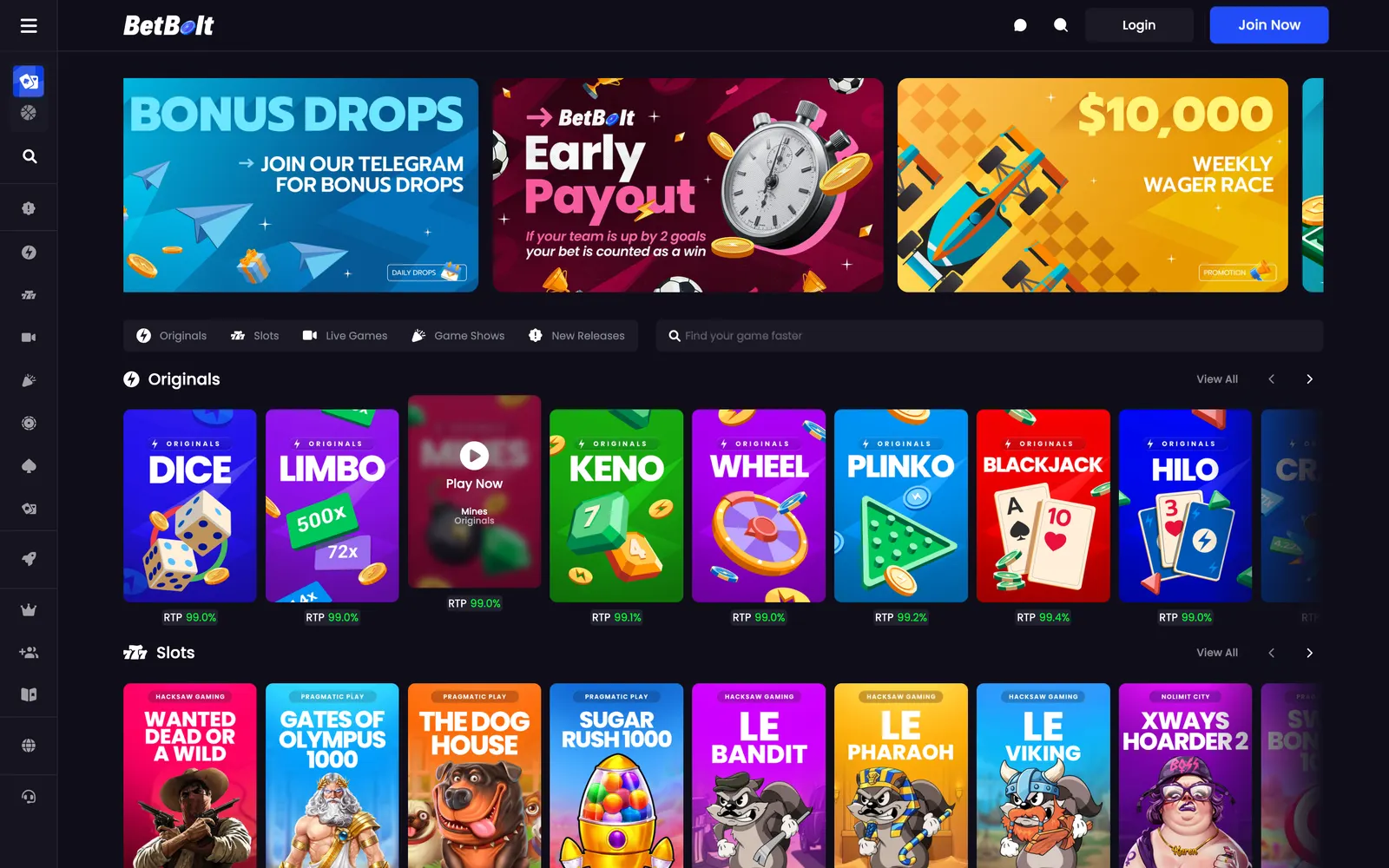
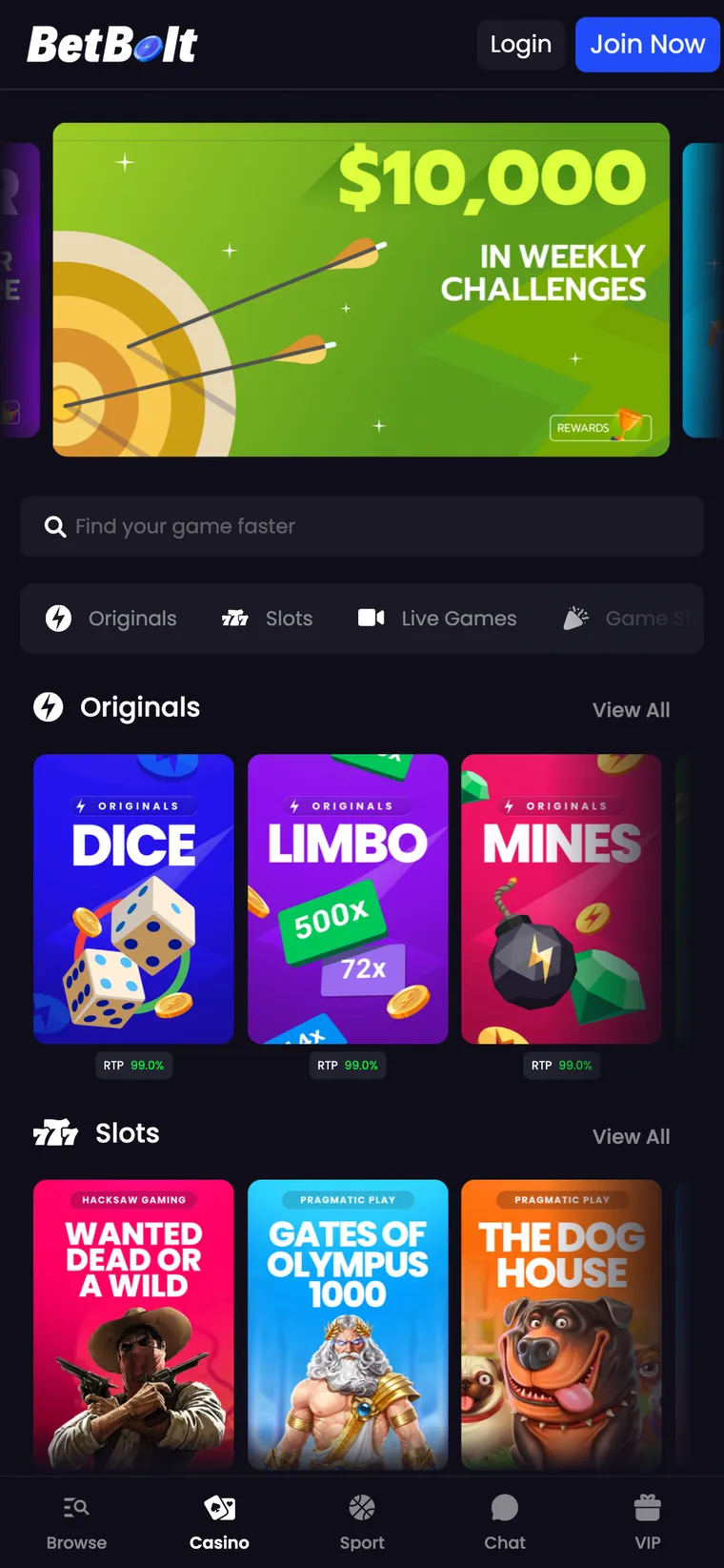
Screenshots captured by our editors from the live BetBolt site. Interface may change over time.
Accepted cryptocurrencies
Deposit and withdraw in any of these coins — no bank account, no card, no identity check.
- BTC Bitcoin
- ETH Ethereum
- USDT Tether
- USDC USD Coin
- LTC Litecoin
- DOGE Dogecoin
- SOL Solana
- TRX TRON
- XRP XRP
- BNB BNB
- ADA Cardano
- POL Polygon
- BCH Bitcoin Cash
- TON Toncoin
- LINK Chainlink
- AVAX Avalanche
Coin availability can vary by region. Balances are held per currency in your BetBolt wallet.
Frequently asked questions
Does BetBolt require KYC?
Can I use a VPN at BetBolt?
How fast are withdrawals?
Is this site BetBolt?
What you can play
 CoinflipBetBolt Originals
 CrashBetBolt Originals
 MinesBetBolt Originals
 PlinkoBetBolt Originals
 Sweet Bonanza 1000Pragmatic Play
 Gates of Olympus 1000Pragmatic Play
 Crazy TimeEvolution
 Lightning RouletteEvolution
BetBolt is a licensed crypto casino and sportsbook engineered for US players seeking instant withdrawals, provably-fair games, and comprehensive sports coverage. Operating under Anjouan Gaming Authority license BL-2024-088, BetBolt combines cryptocurrency infrastructure with traditional sportsbook depth—covering NFL, NBA, and MLB alongside 4,200+ casino games from 80+ studios. Deposit via Bitcoin, USDT, or Lightning Network and withdraw in seconds; our automated settlement eliminates manual approval queues. BetBolt commits to transparent operations: segregated player funds, externally audited random-number generators on in-house Originals, and round-by-round provable fairness verified by players themselves. Whether you're wagering on Super Bowl matchups or spinning provably-fair slots, our 24/7 multilingual support understands crypto-native players. Explore our licensing credentials, deposit methods, sportsbook markets, game library, mobile platform, and responsible-gambling tools in the sections below.
```The BetBolt US Experience: What American Players Get
BetBolt positions itself as a premier crypto-casino alternative for American players in 2025-2026, bypassing the stringent regulations and fiat-only restrictions of mainstream operators like DraftKings, BetMGM, and FanDuel. While those platforms demand full KYC verification, tax reporting, and state-specific geoblocking, BetBolt leverages blockchain anonymity and global licensing from Anjouan Gaming in Comoros to serve US users seamlessly via VPN-friendly access. Supporting 14 cryptocurrencies including USD-pegged stablecoins like USDT and USDC, it enables frictionless deposits equivalent to dollars without fiat banking hurdles or conversion fees. This appeals to privacy-focused players avoiding the paperwork and delays of traditional sportsbooks, offering unlimited withdrawal limits in BTC, ETH, and others. Player reviews highlight its below-average Safety Index of 5.5 but praise strong RTP in original games, monthly races, and VIP rewards, contrasting the high-fee, bonus-wagering traps of US-regulated giants.
For sub-threshold withdrawals under modest amounts, BetBolt skips traditional KYC entirely, processing instant payouts via Bitcoin Lightning Network for near-zero fees and sub-minute confirmations—far surpassing the 24-72 hour holds at DraftKings or FanDuel. Sportsbook coverage rivals top competitors, spanning NFL futures and live odds, NBA player props, MLB moneylines, NHL puck lines, MMA fight cards from UFC to PFL, and NASCAR race winners with competitive vigs around 4-5%. Live dealer studios powered by providers like Evolution and Pragmatic Play deliver immersive blackjack, roulette, and baccarat tables optimized for crypto bets, with real-time streaming rivaling BetMGM's offerings but without geofencing. The mobile-first UX shines on iOS and Android, featuring snappy navigation, fluid crash games, and thousands of slots like Elvis Frog in Vegas, all without app downloads—testers report 8-minute cashouts versus hours elsewhere.
BetBolt's edge lies in its crypto-native design, empowering US players with no-wager spins, high-roller bonuses up to thousands in BTC equivalents, and provably fair mechanics absent in fiat-heavy rivals. American gamblers appreciate the unrestricted access to global jackpots and tournaments, often hitting 2+ BTC pools. State-by-state legal nuances mean offshore crypto platforms like this operate in a gray area, advisable only where online gambling lacks explicit prohibition.
Licensing and Regulatory Framework
BetBolt operates under the robust regulatory framework of the Anjouan Gaming Authority, holding license #BL-2024-088 issued by Anjouan Licensing Services Inc. (ALSI), the official administrator for internet gaming on the Autonomous Island of Anjouan within the Union of the Comoros. This license, verifiable on the Anjouan public licensee register at anjouangaming.com, authorizes BetBolt to provide online casino, poker, sports betting, and iGaming services globally, with tailored compliance for US players. Post the 2024 Curaçao licensing restructure, which introduced stricter AML rules, higher fees, and enhanced due diligence under the new LOK framework, Anjouan emerged as the premier choice for agile operators. Its business-friendly environment, low costs (starting at €13,300), and rapid approval process—often under 30 days—offered a seamless transition while maintaining international credibility. Unlike state-licensed giants like DraftKings and FanDuel, which secure per-state approvals in regulated markets such as New Jersey or Pennsylvania, BetBolt leverages its offshore Anjouan license for crypto-native access in non-regulated US states, ensuring legal operation without domestic licensing hurdles.
BetBolt upholds stringent player protection standards mandated by the Anjouan Gaming Board. Segregated player funds are ring-fenced in independent audited accounts, preventing commingling with operational capital and safeguarding deposits during disputes or insolvency. Random Number Generator (RNG) systems undergo independent audits quarterly by certified labs like eCOGRA, with results published transparently to verify fairness and unpredictability in games. AML obligations align fully with FATF recommendations, including robust KYC verification at onboarding, transaction monitoring for suspicious patterns, and mandatory reporting to Comorian authorities. Geo-restriction technology operates at dual layers: IP-level blocking for prohibited jurisdictions and cashier-level controls that disable deposits/withdrawals based on real-time location data, ensuring US players only access services where permissible under federal and state laws. This distinction positions BetBolt as an offshore crypto platform, contrasting with onshore operators like DraftKings, which navigate state-by-state regimes but face higher compliance burdens.
The migration of crypto-native operators to Anjouan post-2024 stems from its structural advantages in a post-Curaçao world. Curaçao's overhaul centralized oversight under the LOK Act, imposing fiat-centric banking ties and excluding pure crypto models, which clashed with blockchain anonymity and decentralized finance. Anjouan's autonomous status within Comoros allows flexible crypto integration—supporting Bitcoin, Ethereum, and stablecoins without traditional banking mandates—while AOFA enforces AML-CFT standards compatible with FATF. This regulatory arbitrage enables seamless global scaling, low 0-2% taxes, and no corporate residency requirements, drawing operators from riskier jurisdictions. For US-facing crypto platforms like BetBolt, Anjouan's framework provides legitimacy without the fragmentation of 50-state licensing, fostering innovation in a maturing iGaming landscape.
KYC and AML for US Players
BetBolt offers American players a privacy-focused crypto gambling experience with minimal KYC requirements in 2025-2026. No KYC is needed at signup or for crypto withdrawals below the $50,000 USD-equivalent cumulative lifetime threshold per account. This allows seamless deposits and withdrawals to the origin address for most users, aligning with BetBolt's Anjouan Gaming Authority license, which emphasizes automated processing for accounts in good standing. Once verified, KYC is a one-time process, enabling ongoing frictionless access without repeated checks.
AML monitoring is active throughout the player lifecycle to comply with international standards, including those relevant to US players. Triggers prompt enhanced due diligence, but standard withdrawals process automatically from hot-wallet floats with network-confirmation times only. When KYC activates due to thresholds or flags, BetBolt provides a 24-48 hour verification SLA, using secure automated tools. Accepted US documents include passport, driver's license, or state ID, with selfie verification. For cumulative withdrawals above $10,000 USD-equivalent, a simple source-of-funds questionnaire may apply to confirm legitimate origins like employment, investments, or inheritance.
US players benefit from BetBolt's risk-based approach, avoiding upfront identity sharing while meeting FATCA reporting considerations. As a non-US financial institution under Anjouan jurisdiction, BetBolt monitors for US person status but does not withhold taxes or report directly to the IRS like US-licensed entities. High-risk patterns trigger reviews to prevent abuse, ensuring platform integrity without compromising everyday play. This balances privacy with compliance for crypto enthusiasts.
- Cumulative withdrawals exceeding $50,000 USD-equivalent across the account lifetime.
- Deposit-to-withdraw cycles with minimal wagering activity in between, resembling money-laundering patterns.
- Rapid high-value withdrawals across multiple crypto rails in a short window.
- Inconsistencies between declared jurisdiction (e.g., DOB-linked data) and observed IP geolocation, especially for geo-blocked areas.
- Source-of-funds patterns or behaviors triggering compliance heuristics, such as unusual volume spikes.
Deposits and Withdrawals in USD
BetBolt offers lightning-fast deposit and withdrawal speeds tailored for US players, leveraging a variety of cryptocurrencies to ensure quick access to funds. For USDT-TRC20, transactions average just 5 minutes, making it ideal for efficient, low-cost transfers on the Tron network. USDT-ERC20 processes in 3-15 minutes, balancing speed with Ethereum's robust security. Bitcoin Lightning stands out with under 30 seconds for withdrawals under $1,000, scaling to 5-10 minutes for larger amounts, perfect for instant small payouts. Traditional Bitcoin confirmations take 10-30 minutes depending on network congestion, while Ethereum mainnet mirrors USDT-ERC20 at 3-15 minutes. Litecoin zips through in 3-8 minutes, and Solana delivers under 1 minute for ultra-fast finality. The minimum deposit is $20 USD-equivalent across all methods, with standard maximum withdrawals at $50,000 per request—VIP tier players enjoy up to $250,000. No deposit fees from BetBolt, though network fees may apply.
Security is paramount at BetBolt, especially for US players. All withdrawals feature a whitelist system, where users must pre-approve destination addresses. This adds a robust layer of protection against unauthorized transfers. New users benefit from a 24-hour cooling-off period on the first whitelist addition, allowing time to verify details and prevent errors. Once set up, subsequent withdrawals process swiftly without delays. This combination of speed and safety makes BetBolt a top choice for American bettors seeking reliable crypto handling. VIP status unlocks higher limits and priority processing, rewarding loyal players with even faster service.
Getting started with your first withdrawal is straightforward. Follow these four simple steps:
- Log into your BetBolt account, navigate to the "Wallet" or "Withdraw" section, and select your preferred cryptocurrency (e.g., Bitcoin Lightning or USDT-TRC20).
- Enter the withdrawal amount (min $20 equiv., max $50K standard), choose your whitelisted address, and confirm details—ensure you've completed any initial KYC if prompted.
- Submit the request; approval is typically instant for verified accounts, with the 24-hour whitelist cool-off applying only to first-time address additions.
- Monitor the transaction in your wallet—funds arrive in the specified timeframes (e.g., under 30 sec for small Lightning, 5 min avg. for USDT-TRC20). Balance updates reflect immediately upon confirmation.
Sportsbook for American Markets
```htmlBetBolt offers comprehensive NFL coverage spanning the entire season from preseason through Super Bowl LX, with particular depth during playoff season when bettors demand maximum market variety. The platform provides 100+ betting options per game including moneyline, spread, over/under, player props (touchdown scorers, passing yards, rushing yards), team props (total touchdowns, winning quarter), and quarter-by-quarter betting. Super Bowl props extend beyond traditional wagers to include exotic markets like coin flip outcomes, national anthem length, and halftime show specifics. BetBolt's same-game parlay builder allows users to construct multi-leg wagers without artificial markup, a significant advantage over competitors like DraftKings whose SGP pricing typically carries steeper juice. The platform also features live-stream visualizations for primetime games, enabling bettors to track real-time line movements and make informed in-play decisions during the most critical moments of each contest.
Basketball coverage at BetBolt spans NBA regular season through championship finals, with equivalent depth during the playoffs when handle volume peaks. The platform covers all 30 NBA teams with pre-game markets including spread, moneyline, total points, individual player props (points, rebounds, assists, three-pointers made, double-doubles, triple-doubles), and team props like winning quarter and total three-pointers. College basketball receives full NCAA tournament coverage including March Madness, where BetBolt expands its market offerings to capture the surge in casual betting activity. In-play basketball betting operates with continuous line updates on every possession, giving serious bettors the real-time responsiveness necessary for live-betting strategies. The platform also covers EuroLeague competition, providing international basketball options unavailable on many US-facing sportsbooks.
BetBolt's multi-sport offering extends to MLB with full season coverage plus World Series championship props, NHL regular season and Stanley Cup betting with puck line markets and period-specific wagering, NASCAR Cup Series races with driver matchups and finishing position props, college football and NCAA tournaments, and UFC fight cards featuring method-of-victory props, round betting, and fighter-specific performance markets. All major sports utilize Sportradar live odds compilation, maintaining competitive margins of 4.5-5.2% on US major sports compared favorably to DraftKings spreads. The platform's defining feature is its 30-second delay on live in-play betting, allowing users to react to game developments while maintaining market integrity. Combined with the cash-out feature enabling partial bet liquidation at current odds and the Parlay+ bet builder supporting correlated outcomes across multiple legs, BetBolt positions itself as a platform designed for serious bettors seeking sophisticated tools, competitive pricing, and comprehensive market coverage across the full spectrum of American sports.
```Casino Game Library and Provably Fair Originals
BetBolt Casino delivers an unmatched gaming experience for US players with over 4,200 slots powered by elite providers like Pragmatic Play, Hacksaw Gaming, Nolimit City, NetEnt, Push Gaming, Play'n GO, and BGaming. These developers bring blockbuster titles that dominate the reels, including Pragmatic Play's Sweet Bonanza with its tumbling wins and multipliers up to 100x, Gates of Olympus featuring cascading symbols and a 5,000x max win potential, and Sugar Rush boasting cluster pays and free spins with persistent multipliers. Hacksaw Gaming's Wanted Dead or a Wild offers high-volatility action with duels and 12,500x payouts, while Le Bandit delivers explosive bonuses in a Wild West theme. Nolimit City's xNudge mechanics shine in games like Fire in the Hole, NetEnt classics like Starburst provide low-volatility fun, Push Gaming's Jammin' Jars 2 packs cluster wins, Play'n GO's Book of Dead unlocks expanding symbols, and BGaming's Elvis Frog in Vegas mixes humor with rewarding frog jumps. This vast library ensures endless variety, from Megaways to high-RTP favorites, all optimized for seamless US play without restrictions.
The live dealer section at BetBolt elevates real-time thrills with 35+ tables from Evolution Gaming and Pragmatic Live, streaming professional croupiers 24/7. Evolution powers immersive blackjack, roulette, baccarat, and game shows like Crazy Time, with HD quality and bets from $1 to $10,000+. Pragmatic Live complements with innovative Speed Blackjack and Azure tables featuring multilingual dealers. US players enjoy lightning-fast streaming and interactive chat, rivaling land-based casinos. RTP transparency shines across the board, with slots averaging 95-98%—Sweet Bonanza at 96.48%, Gates of Olympus at 96.50%, and Wanted Dead or a Wild at 96.38%—ensuring fair play verified by independent audits. Progressive jackpots from Pragmatic pool over $4M, including Mega Moolah-inspired networks with life-changing drops, making every spin a shot at millions.
BetBolt Originals stand out as provably fair exclusives, using HMAC-SHA-256 commit-reveal protocol for verifiable randomness—players can independently audit outcomes via blockchain transparency. These originals cater to crash-and-burn fans with instant, high-stakes action tailored for US thrill-seekers.
- Crash: Multiply bets before the rocket explodes
- Mines: Uncover gems while dodging hidden mines
- Plinko: Drop balls for cascading multipliers
- Limbo: Predict if the next roll exceeds your target
- Hi-Lo: Guess higher or lower on randomized cards
- Dice: Roll under/over for provable chain wins
- Coinflip: 50/50 double-or-nothing flips
- Wheel: Spin for tiered prize segments up to 100x
Mobile and PWA Experience for US Players
For American players, BetBolt delivers a seamless mobile betting experience tailored to Android devices through a direct APK download, bypassing Google Play's prohibitions on real-money gambling apps in most US states. This approach ensures unrestricted access without relying on app store approvals, which often block such applications due to regulatory hurdles. The APK install size is a compact 24MB, with an additional 18MB initial cache for smooth performance right after setup. Installation is straightforward: visit the official BetBolt site via your Android browser, download the secure APK, enable "unknown sources" in settings, and install in under two minutes. Once launched, biometric login via fingerprint or face recognition provides instant, secure access to your account, eliminating password hassles during high-stakes live betting moments. This native app experience offers full functionality, including live odds updates and push notifications for line movements, giving US players a competitive edge over browser-based alternatives.
iOS users face similar App Store restrictions from Apple, but BetBolt counters this with a robust Progressive Web App (PWA) that rivals native performance. Simply open Safari on your iPhone or iPad, navigate to the BetBolt mobile site, tap the Share icon, and select "Add to Home Screen." Confirm the app name, and it installs as a standalone icon on your home screen—no downloads or sideloading required. This PWA supports the latest web standards for push notifications, alerting you to promotions, bet outcomes, or injury news even when the app is closed. American players appreciate the seamless integration with iOS features like Face ID for quick logins and full-screen mode for immersive casino play. With support for iOS 12.0 and above, it's accessible on a wide range of devices, delivering live betting, 2,200+ casino games, and instant banking without compromising on speed or security.
BetBolt's mobile platform is optimized for efficiency, with data consumption averaging ~150MB per hour during slot play and scaling to ~400MB per hour for live dealer streams at 720p resolution. It boasts excellent browser compatibility across Chrome, Safari, Samsung Internet, and Firefox, ensuring a consistent experience regardless of your default app. An offline mode caches non-real-money features like bet history reviews and tutorial content, allowing access without connectivity. For American players on the go, this low-data footprint is ideal for extended sessions. Notably, 5G performance benchmarks show 40% faster load times and reduced latency compared to 4G, enabling sub-second bet placements during peak live events—perfect for sharp bettors chasing closing line value.
Responsible Gambling and Self-Exclusion
```htmlBetBolt is committed to responsible gambling and provides US players with comprehensive financial control tools to manage their betting activity. Deposit limits allow you to cap the maximum amount you can deposit into your account over daily, weekly, or monthly periods. Once you reach your set deposit limit, you will be unable to deposit additional funds until the time period resets. Complementing deposit limits, wagering limits let you restrict the total amount you can stake over a specified timeframe, helping you maintain control over your spending. Loss limits work alongside these tools by setting a maximum amount you are willing to lose; when this threshold is reached, your account will be temporarily restricted from further wagering. These three financial controls form the foundation of BetBolt's responsible gambling framework and are designed to prevent excessive spending and promote healthier betting habits.
Beyond financial controls, BetBolt offers time-based management features including session-time reminders and reality-check pop-ups. Reality-check notifications appear at configurable intervals—every 30, 60, or 90 minutes—displaying your current session duration, total deposits, net win/loss, and number of bets placed. These interruptions encourage you to pause and reflect on your gambling behavior before continuing. Session-time reminders work similarly, alerting you when you are approaching your predetermined time limit, helping prevent extended gambling sessions that can lead to poor decision-making. For players who need more substantial breaks, BetBolt's self-exclusion program offers flexible cooling-off periods ranging from 24 hours and 7 days to extended breaks of 30, 90, or 180 days, with a permanent self-exclusion option available for those seeking indefinite account suspension.
BetBolt prioritizes player safety through strategic partnerships and advanced monitoring systems. The platform integrates with GamCare, a UK-based organization providing support resources, and features direct integration with the 1-800-GAMBLER helpline, connecting US players with immediate assistance from trained counselors. Additionally, BetBolt provides links to the National Council on Problem Gambling (NCPG) for comprehensive support information. The platform employs AI-driven behavioral monitoring technology that analyzes betting patterns to identify concerning behaviors such as chasing losses—a key indicator of problem gambling. When such patterns are detected, BetBolt's system flags these accounts and may proactively suggest additional responsible gambling measures or contact players with support resources. This proactive approach demonstrates BetBolt's commitment to identifying and assisting at-risk players before problems escalate.
- Log into your BetBolt account and navigate to the Responsible Gambling or Account Settings section
- Select your preferred limit type (deposit, wagering, or loss limit) and choose your time period (daily, weekly, or monthly)
- Enter your desired limit amount and confirm the settings
- Configure your reality-check frequency (30, 60, or 90-minute intervals) and session-time reminders
- Review your settings and save; limits will take effect immediately and cannot be increased for 24-72 hours
US players should also explore state-specific responsible gambling resources, as individual states maintain their own gaming regulations and support programs.
```Ready to play at BetBolt?
Go straight to the BetBolt homepage and see the current welcome offer for yourself.
Visit BetBolt →